 ace
Pengembangan Kreativitas Digital Siswa SMA 1 Sedayu melalui Pelatihan Prompt Engineering Berbasis Framework Role-Task-Context
The rapid development of Generative Artificial Intelligence (AI) has transformed learning and working paradigms, shifting the primary challenge from merely seeking information to the ability to formulate precise instructions (prompting). Despite high technology access in Senior High Schools (SMA), its utilization remains largely superficial. This research aims to enhance students' AI literacy skills—encompassing conceptual understanding, ethical awareness, and information verification—through structured prompt e…
In brief
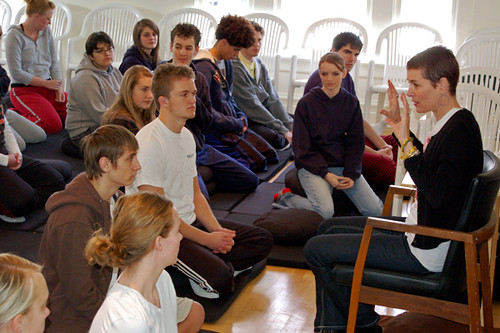
Researchers ran a training program at SMA 1 Sedayu in Bantul, Yogyakarta, teaching students to write structured instructions for generative AI using the Role-Task-Context framework. Students practiced on mobile devices, and their scores were compared before and after the sessions.
The result suggests that short structured training can move students from superficial use of AI toward more deliberate use of it. However, the design had no comparison group and covered a single school, so it is unclear whether the gains would last or apply elsewhere.
Main points
- The study used a pre-experimental one-group pretest–posttest design with 31 students.
- Mean scores rose from 57.10 before training to 89.68 after training.
- Statistical tests included a paired t-test, with |t-Stat| of 18.16 above the critical value of 2.04 (p < 0.05).
- A Pearson correlation of 0.759 was reported as showing consistency in adopting the new techniques.
- The target skills were conceptual understanding, ethical awareness, and information verification.
The gain
After Role-Task-Context prompt engineering training with hands-on mobile practice, 31 SMA 1 Sedayu students raised their mean AI literacy score from 57.10 to 89.68 on the study's assessment.
The rundown
The authors frame the problem as a shift in the main challenge from finding information to formulating precise prompts. They note that although Senior High Schools have high technology access, students' use of it remains largely superficial.
The intervention combined instruction in the Role–Task–Context framework with hands-on practice on mobile devices. Analysis involved normality tests (Shapiro-Wilk and Kolmogorov-Smirnov), Spearman correlation, and paired samples t-tests.
The authors conclude that treating prompt engineering as a life skill can shift students' digital behavior from entertainment toward productivity and strengthen digital literacy in the digital creative economy.
Sources
- Peer-reviewedJurnal Pengabdian Masyarakat - Teknologi Digital Indonesia.2026-10-20

Digital Competence and Organizational Support as Determinants of Artificial Intelligence Technology Adoption Among High School Teachers
Nusantara Science and Technology Proceedings
The Differential That Never Gets Generated
International Journal of Dermatology
Within-person reciprocal processes between AI feedback literacy and agentic engagement: a three-wave random-intercept cross-lagged panel study
Frontiers in Psychology
The debate