 ace
AI effects on Tamil Nadu's labour market
Source article: AI & automation: More jobs in TN set to gain, many at stake
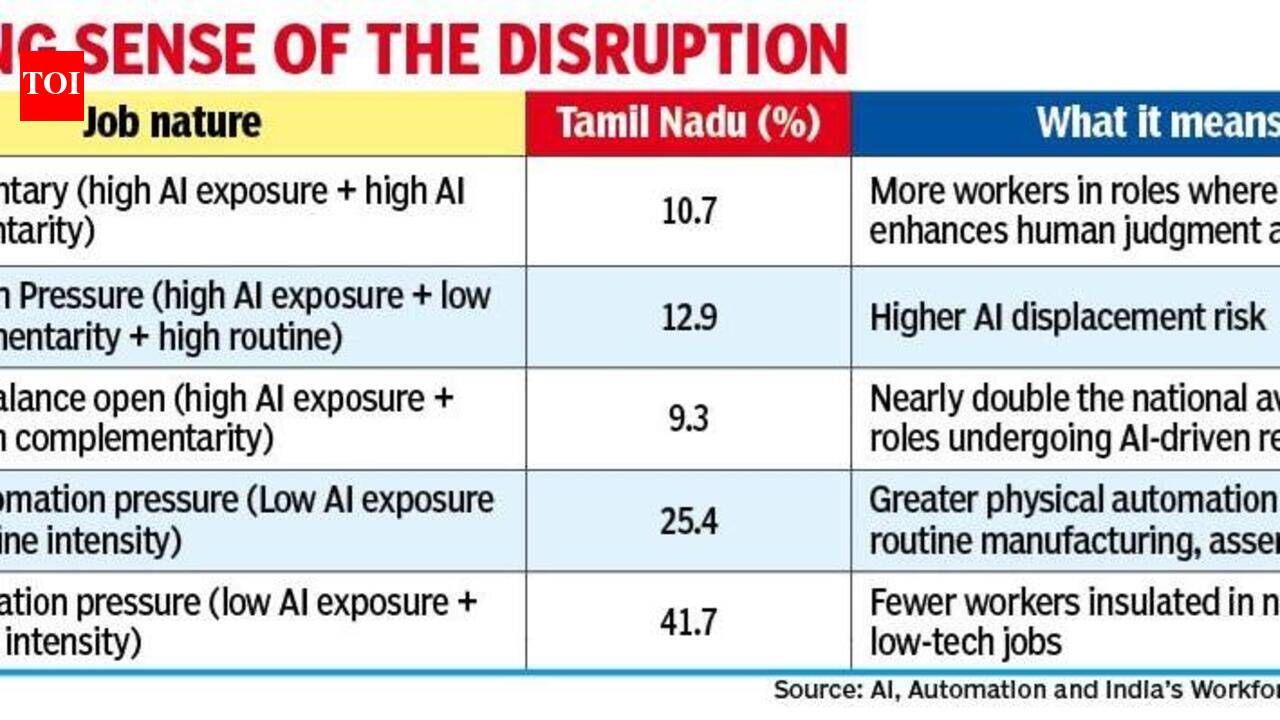
Tamil Nadu has 10.7% of jobs likely to gain from AI but faces above-average substitution (12.9%) and automation pressure (25.4%), a study finds. Tamil Nadu has a higher share of jobs with complementary effects from AI at 10.7% A new study suggests that AI could benefit Tamil Nadu’s labour market, with a higher share of jobs in sectors where workers are expected to gain productivity from AI. B
Both sides are scored from claims and sources, not community votes.
G 60The G score combines the specificity and measured human impact of the grounded gain claim with the strength of this Trace’s cited sources.In brief
A new study examines how AI could reshape employment in Tamil Nadu. It finds the state has a relatively large share of jobs where AI is expected to complement workers and raise productivity, at 10.7%.
The same analysis shows the state is not shielded from disruption. Its shares of jobs exposed to substitution and automation pressure are above average. The supplied text is only an excerpt, so the study's method, the comparison benchmarks and the timing of any effects remain unclear.
Main points
- Complementary AI effects reach 10.7% of jobs in Tamil Nadu, which the study describes as a higher share.
- Jobs facing AI substitution account for 12.9%, which is above average.
- Automation pressure affects 25.4% of jobs, also above average.
- The study suggests AI could benefit the state's labour market through productivity gains in some sectors.
The gain
A study finds 10.7% of Tamil Nadu jobs are in sectors where AI is expected to complement workers and raise their productivity, a higher share than elsewhere.
The problem
The same study finds Tamil Nadu has above-average exposure to AI substitution (12.9%) and automation pressure (25.4%), putting a substantial share of its jobs at stake.
The rundown
The study's central finding is that Tamil Nadu's job mix includes a larger share of occupations where AI works alongside workers. In these sectors, workers are expected to gain productivity from the technology.
The study also reports above-average exposure to two displacement measures. Substitution stands at 12.9% and automation pressure at 25.4%. The headline frames these as many jobs being at stake.
The supplied article text is truncated, so it does not say which sectors or occupations are most affected, who conducted the study, or how the percentages were calculated.
Sources
- JournalismTimes of India2026-10-18

Year-long internships offered to 3,000 tertiary students to counter AI threat to entry-level jobs
The Straits Times
A Concern for Entry-Level Jobs
The Economic Times
Calls to strengthen workplace privacy in Australia as employers turn to AI to track staff
The Guardian
The debate