 ace
Tencent built an empire on WeChat and gaming. Can it keep up in China's AI race?
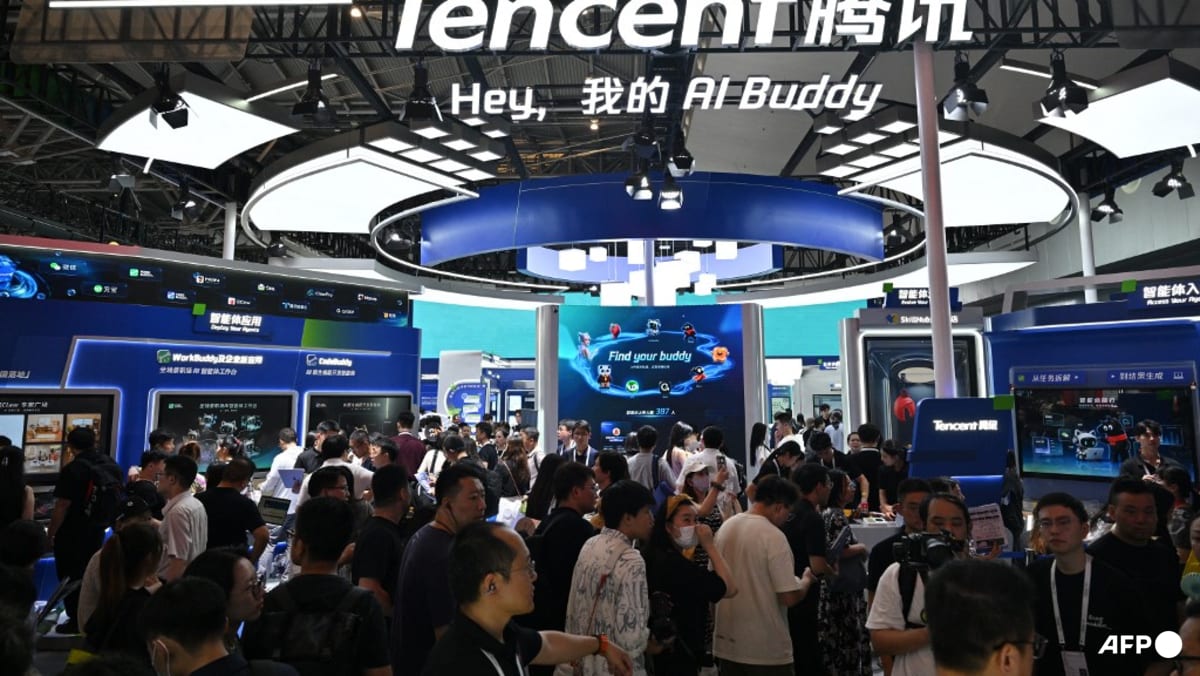
As AI reshapes China's tech industry, Tencent faces growing competition from rivals and AI startups. But the Chinese conglomerate’s vast WeChat ecosystem and gaming business could still give it an edge. SHANGHAI/BEIJING: Like many people in China, Gu Jiu rarely goes a day without using WeChat. The Shanghai resident checks his unread messages and catches up on friends' posts on the app before leaving home. He uses WeChat Pay to buy his morning coffee
In brief
Tencent, the company behind WeChat, has faced questions through much of 2026 over whether it is falling behind in China's AI race. QuestMobile data cited by CNA show ByteDance's Doubao had 382 million monthly active users in June, against about 50 million for Tencent's Yuanbao chatbot.
The contest matters because WeChat had more than 1.4 billion monthly active users at the end of the first quarter of 2026, and analysts say AI could take over some roles played by platforms like WeChat and Douyin. Zhipu, an AI developer, briefly surpassed HK$1 trillion in market value in June, showing how startups are reshaping the field.
Tencent's cautious approach reflects the risks of changing services that hold payment details, identity information and private conversations. Its WeChat assistant Xiaowei, launched in June, has already raised privacy concerns, and analysts disagree on whether WeChat's reach and its roughly 4 million mini programmes will let Tencent catch up.
Main points
- QuestMobile figures put Doubao at 382 million monthly active users in June versus about 50 million for Tencent's Yuanbao.
- Zhipu, a Hong Kong-listed AI developer, briefly surpassed HK$1 trillion (US$128 billion) in market value in June.
- Tencent launched the Xiaowei assistant inside WeChat in June, but its introduction has raised privacy concerns.
- WeChat has roughly 4 million mini programmes that could become valuable if AI agents could call them on behalf of users.
- Tencent's enterprise WorkBuddy agent launched in June, while ByteDance answered with Doubao Work and Baidu with DuMate.
- Gaming is about a third of Tencent's revenue, which rose from about 57 billion yuan to nearly 242 billion yuan in a decade.
- Honor of Kings had more than 260 million monthly players worldwide by 2025, and Tencent is testing AI teammate features in games.
The problem
Tencent's Yuanbao chatbot had about 50 million monthly active users in June, far behind ByteDance's Doubao at 382 million, while investor concerns over its AI strategy weighed on its Hong Kong-listed shares.
The rundown
Analysts describe China's AI market as highly fragmented, unlike what Rui Ma called an almost duopoly between OpenAI and Anthropic in the United States. Independent analyst Pei Pei said the story has shifted from Tencent versus ByteDance to traditional tech versus AI, with startups such as Zhipu rising quickly.
Tencent has been more measured than Alibaba and ByteDance, whose founders committed resources early. Ma said mistakes at the scale of a billion-plus users would be very expensive, and WeChat's handling of payment, identity and private conversation data makes generative AI's unpredictable output a particular risk.
On the upside, Ma said that if AI agents could call WeChat's roughly 4 million mini programmes, going online would become a different experience. Analyst Chen Zemin said Doubao still has a substantial lead in reach and influence but that Tencent has enormous potential.
In gaming, Tencent's international revenue exceeded US$10 billion for the first time in 2025, offsetting China's 2021 limit on under-18 play. AI teammates in Peacekeeper Elite and Honor of Kings could match a player's skill level, but developers are sceptical of AI-controlled characters or storylines, and Pei said investor expectations for AI in games are unrealistic.
Sources
- JournalismCNA2026-11-04

Tech sell-off drives US markets down by nearly $1tn after subpar earnings reports
The Guardian
Disquiet grows in Albanese’s back yard as Grayndler artists unite against ‘insane’ AI proposal
The Guardian
AI is stealing Indigenous Australian art and churning out ‘Temu slop’, artist says
The Guardian
The debate