 ace
Emerging evidence
More
I asked Lovable, Bolt, and Google AI Studio to build the same web app, and one is in a different league
- Evidence type
- News report
- Sample
- n = 2
- Sources
- 1 sourceJournalism
- Published
- 3 min read
- Truvace record
- TRV-2026-3014cite or check it
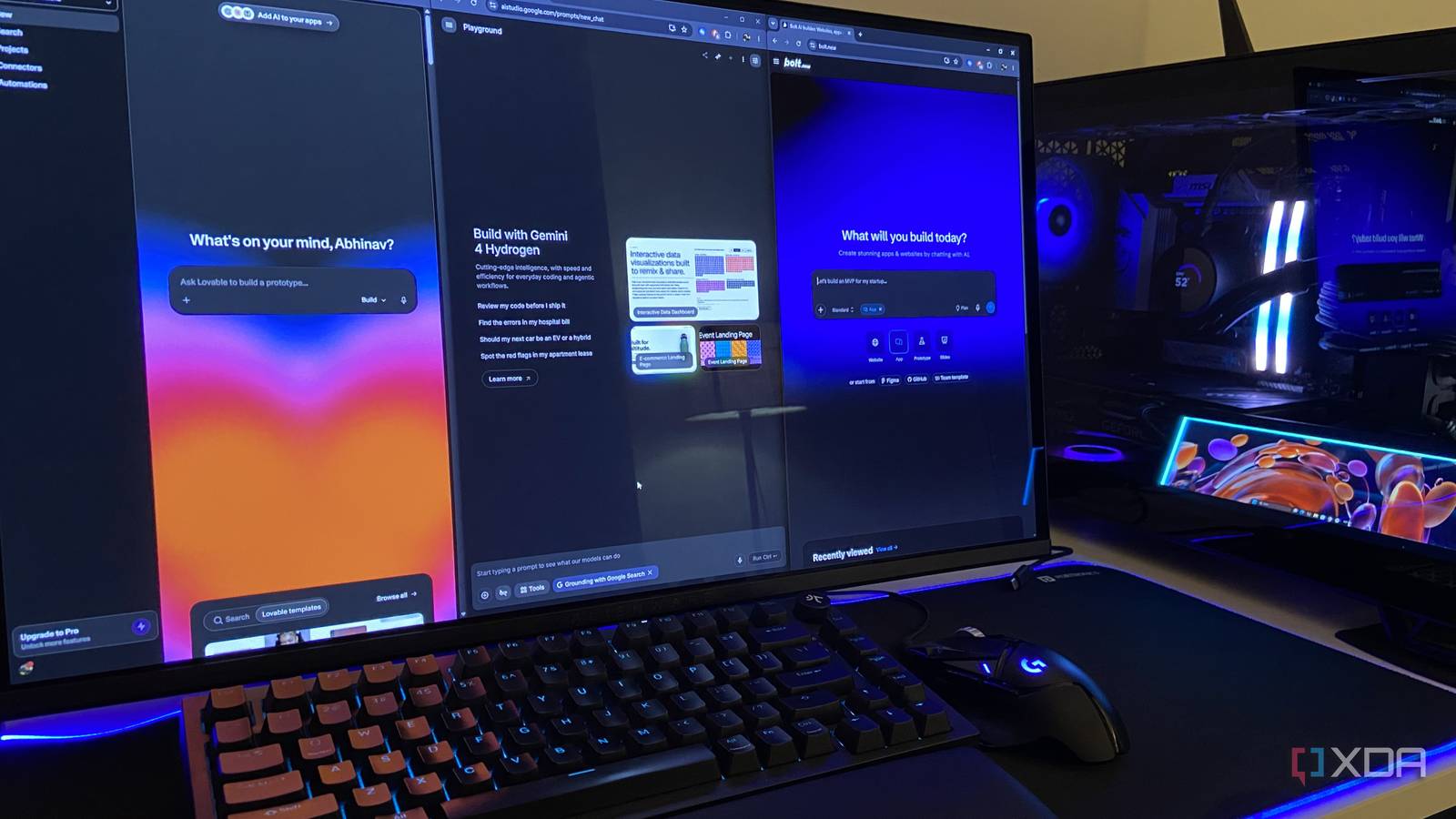
All three got the math right, but only one understood the meaning behind the numbers If you have the vision of an application, and the words to describe it, there are many no-code AI services that can deliver it to you with just a prompt. Three of those apps that have gotten increasingly popular amongst vibe coders and developers ali
42Gain side
How the two sides scoreClose call
44Problem side
The gain
In one reviewer's single-prompt test, Lovable's benchmark app matched the other two on the 75 FPS and 57 FPS caps, then correctly traced the stutters to loading or shader compilation early in the run.
The problem
In the same hands-on test, Bolt labelled both Jedi Survivor runs choppy despite four of six slow frames falling in the first two seconds, and Google AI Studio's app advised stepping down to 0 FPS and 1 FPS.
A fixed formula sets both scores from the evidence and its sources. Reader votes don’t move them.
What the scores mean
G is the gain side, out of 100. It goes up when the gain is specific, when it measurably helped people and when the sources behind it are strong.
P is the problem side, out of 100. It goes up when the problem is specific, when it measurably hurt people and when the sources behind it are strong.
In brief
A XDA Developers writer gave Lovable, Bolt and Google AI Studio the same prompt: build a web app that reads CapFrameX or PresentMon frametime CSVs and explains in plain English how smooth a game run was. He used two captures, a minute of Star Wars Jedi Survivor at max settings and a shorter second run, with no fix prompts or hand edits.
All three apps computed the same frame-rate caps, 75 FPS for the first run and 57 FPS for the second. They differed in interpretation. Bolt scaled its graph around a 1.27-second freeze at the start and called both runs choppy, while Google AI Studio's app suggested stepping down to 0 FPS and, on the second capture, 1 FPS.
Lovable was the fastest to finish and the only app the writer said he would open again, because it attributed the early hitches to loading or shader compilation. The result is one reviewer's single-shot test on one game, so it says little about how the tools perform generally.
Main points
- The prompt asked for average FPS, 1% low, frames over 50 ms with timing, a frametime graph and a frame cap equal to the highest rate held for 99% of the run.
- Bolt reported 118.1 FPS average, a 26.2 FPS 1% low and six frames over 50 ms with accurate timestamps, plus a 75 FPS cap and a correct 57 FPS cap for the second run.
- Bolt's graph was scaled around a 1.27-second freeze, flattening the rest of the minute into a line along the floor.
- Bolt's code prints its choppy verdict whenever the 1% low falls below 60% of the average, regardless of when or how often hitches occurred.
- Google AI Studio, using Gemini 4 Hydrogen, built the most in 4 minutes 51 seconds, with a zoomable graph, a stutter log, a cap table from 30 to 120 FPS and a .txt export.
- Google AI Studio's amber note advised stepping down to 0 FPS on the first capture and 1 FPS on the second.
- Lovable finished fastest, matched the caps, and recommended using the in-game limiter or RTSS to hold the cap.
The full story
The writer, who benchmarks hardware for a living, wrote the prompt in benchmarker jargon and explained none of it, to see whether the underlying models could cope without hand-holding. Every app got one attempt on the same two captures.
Bolt's arithmetic was right, but the interpretation was not. A 1.27-second freeze at the start of the Jedi Survivor run distorted its graph, and its verdict called both runs choppy. The writer checked the code and found a fixed rule that prints the same sentence whenever the 1% low falls below 60% of the average.
Google AI Studio had the most polished interface and features, including drag-to-zoom and a table showing how much of the run each cap from 30 to 120 FPS would hold. Its main cap recommendations were correct, but the note suggesting 0 FPS and then 1 FPS was a flaw that the writer said matters when each app gets one shot.
Lovable noticed the hitches were bunched at the start and attributed them to loading or shader compilation without over-analysing. The writer said that kind of judgment would save him hours when reviewing many graphs, while noting that Google AI Studio shows potential if a user fine-tunes afterwards.
What this doesn’t fix
The comparison is a single informal test by one reviewer, using one prompt, one game (Star Wars Jedi Survivor) and two captures, with no fixes allowed.
Sources
1 on file- XDA Developersxda-developers.com
Talk it over
Bolt called both Jedi Survivor runs choppy while Lovable traced the early hitches to loading or shader compilation. Which matters more in a tool like this, correct arithmetic or sound interpretation, and why?
I asked Lovable, Bolt, and Google AI Studio to build the same web app, and one is in a different leaguehttps://truvace.com/item/i-asked-lovable-bolt-and-google-ai-studio-to-build-the-same-web-app-and-one-is-i
Bolt called both Jedi Survivor runs choppy while Lovable traced the early hitches to loading or shader compilation. Which matters more in a tool like this, correct arithmetic or sound interpretation, and why?
Answer in the threadThis was one reviewer, one prompt, one game and two captures, with each app getting a single attempt. What would you want to see repeated before trusting the ranking of Lovable, Bolt and Google AI Studio?
Answer in the threadGoogle AI Studio's app advised stepping down to 0 FPS and then 1 FPS. If you were the reviewer with many graphs to check, what would you do with a tool that makes errors like that?
Answer in the thread
If you have more time
The writer benchmarks hardware for a living and wrote the prompt in jargon without explaining it. How might the results change if a newcomer had written the prompt?
Answer in the threadBolt's code prints its choppy verdict whenever the 1% low falls below 60% of the average. What would you look up about how other benchmark tools judge smoothness, and how would you compare them?
Answer in the thread





What readers say